CNC vs CNP Fit Factor Explanation

All respirators leak. The question is how much. We need to know if a respirator can fit a wearer well enough to reduce leakage. The reference passing fit factor used for any respirator is intended to ensure the measured leakage in a fit test is low enough to show a respirator can provide the expected level of protection. This is one benefit of quantitative fit testing. Quantitative fit testing uses a machine to provide an objective measurement of respirator leakage.
There are two main types: Controlled Negative Pressure (CNP) and Condensation Nuclei Counting (CNC) – this is sometimes called ambient aerosol or Ambient Particle Counting (APC). These both measure a type of leakage and provide a fit factor, but they do it in very different ways. This means that the reported fit factors will look very different from each other. The fit test protocols are also specific to the technology you are using. Some reference passing fit factors are also technology-specific.
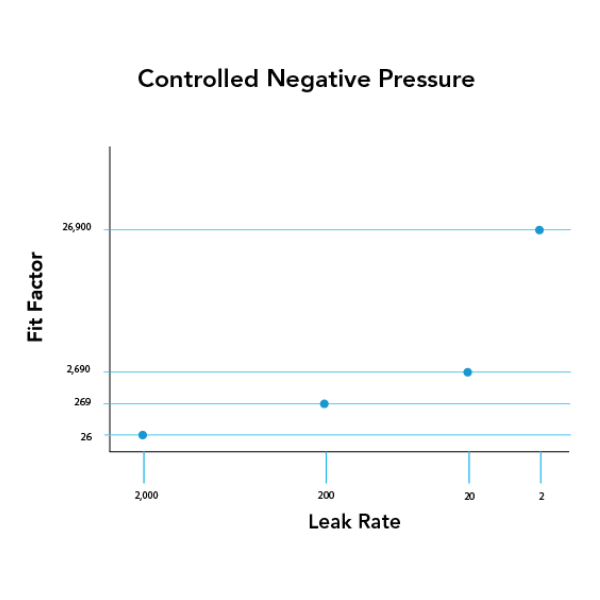
CNP Fit Factor
A CNP fit factor for an individual fit test step is the ratio of a breathing rate (think of it as the total air inhaled) to the measured air leakage (the possibly contaminated air inhaled).
CNP Fit Factor = BR / LR
Where:
BR = modeled breathing rate associated with CNP challenge pressure expressed in L/min;
LR = measured leak rate expressed in cc/min (so, measuring all the air that leaks in – the air that any contaminants would leak in with)
The BR is a set value based on inspiratory flow rate research at different work rates and set by the protocol selected and/or respirator used. For instance, with the Redon protocol, the breathing rate is 53.8 L/min. This value stays constant and is challenging the septillions of air molecules in the ambient atmosphere to enter the respirator. Only the leak rate will vary, based on the fit, and the lowest leakage reportable is 2 cc/min. This means the highest possible fit factor for an individual step in the CNP fit test would be a 26,900 (53.8 L/min converts to 53,800 cc/min divided by 2 cc/min).
CNC Fit Factor
By comparison, a CNC fit factor for an individual test step is the ratio of the concentration of ambient particles counted in a sample of air outside of the respirator (think of these as the inhalation hazard) to the concentration of particles inside the respirator (those that have leaked in).
CNC Fit Factor = Cout / Cin
Where:
Cout = concentration of particles in a sample outside of the respirator in the surrounding ambient air
Cin = concentration of particles in a sample inside the respirator (so, only counting particulate contaminant within the sample leaked air)
The ambient concentration counted can vary greatly depending on the testing environment, and the concentration counted inside the respirator could be as low as 0, but because we cannot divide by a 0, the machine will divide by the lowest concentration that it reports, let’s say .3 particles per set amount of air sampled from the respirator during the test step. For example, if the ambient concentration were held at 30,000 (this is an unlikely scenario, as the concentration will vary during the test, but for some easy math), and no particles were counted inside the respirator, then you would get a 100,000 fit factor (30,000/.3).
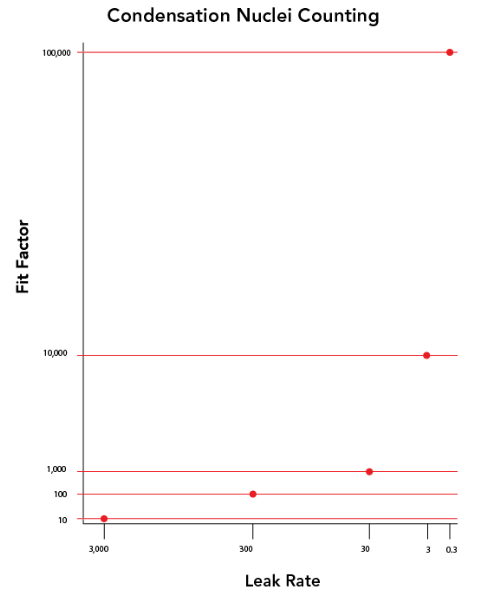
These CNC fit factors are not directly comparable to CNP fit factors, because they are based on different scientific principles. What is being measured is not the same, the scales are not the same, and therefore, the resulting fit factors are not the same.
The Difference Between CNC and CNP Fit Factors
One sometimes confusing aspect is that at the end of a fit test, both technologies take their individual exercise fit factors (calculated in their completely different ways), and provide an overall fit factor that is calculated in the same way according to the formula below:
Overall Fit Factor = N / [1/FF1 + 1/FF2+….+1/FFN] Where:
N= The number of exercises;
FF1= The fit factor for the first exercise;
FF2= The fit factor of the second exercise;
FFN= The fit factor of the Nth exercise.
It’s important to understand that a higher or lower fit factor between technologies doesn’t necessarily mean one respirator performed better or worse. It simply reflects how each technology defines and detects leakage.
Both methods are validated, standardized, and capable of confirming an adequate fit when used correctly and interpreted within their own context. A fit factor of 500 achieved with CNP does not represent the same measurement as a 500 achieved with CNC. However, they can both represent an acceptable fit. What matters is whether the result meets the required reference fit factor for the specific standard, test method, and respirator type.
A common source of confusion is when people compare CNP and CNC fit factors side by side and assume the numbers should match. They shouldn’t, and they won’t. Each method measures leakage using completely different principles and units. CNP measures airflow leakage under controlled pressure, while CNC measures particle leakage in concentration.
Because the inputs, sensitivities, and measurement limits differ, the resulting fit factors exist on different scales. Neither approach is “better”, they simply offer different insights. One or the other (or both) might be better for your respiratory protection program based on the respirators you’re using, the hazards you’re facing, or the environments in which you are testing.
How OHD Can Help
OHD is the only company in the world that manufactures and sells both OSHA approved types of quantitative respirator fit testing, CNC and CNP. The QuantiFit2 uses CNP, while the AeroFit uses CNC. Having both solutions allows us to help you select the fit testing device that is right for you and your respiratory protection program with knowledgeable and unbiased support.
By incorporating quantitative fit testing, you’re not just improving fit testing; you’re enhancing compliance, boosting worker confidence, and building a culture of safety that prioritizes employee protection. If you’re serious about taking your safety program to the next level, OHD has the technology that is right for you.
—
Schedule a demo today and take the first step towards ensuring your team has the protection they deserve.