Why Hospitals are Switching to Quantitative Fit Testing Devices like AeroFit

The Challenge of Fit Testing in Healthcare
For hospitals, ensuring proper respirator fit testing is critical to protecting healthcare workers. However, many facilities still rely on qualitative fit testing, a method that is not only time-consuming but also prone to human error. Data has shown that quantitative fit tests are much more reliable than the qualitative tests in widespread use throughout the health care industry.
With increasing compliance demands, healthcare organizations need a faster, more reliable approach. Quantitative fit testing offers a solution—and AeroFit takes it a step further, combining precision with ease of use.
If your hospital is still using qualitative fit testing, here’s why it may be time to rethink your approach.
The Problems with Qualitative Fit Testing
Many hospitals default to qualitative fit testing because it’s familiar, but this method has significant drawbacks:
- Time-Consuming – Each test takes at least 12 minutes, creating inefficiencies in scheduling and staffing
- Subjective & Inconsistent – A pass/fail result depends on whether an employee can taste a bitter or sweet solution, leading to unreliable outcomes
- Ongoing Consumable Costs – The process requires test solutions, nebulizers, and hoods, adding recurring expenses
For hospitals managing large fit testing programs, these challenges add up, creating unnecessary costs and inefficiencies.
Why Quantitative Fit Testing is the Better Choice
Unlike qualitative fit testing, quantitative methods provide objective, data-driven results. Instead of relying on an individual’s ability to detect a taste, quantitative fit testing measures actual respirator leakage, ensuring a higher level of accuracy.
Here’s why more hospitals are making the switch:
- Greater Accuracy – Provides a numerical Fit Factor, eliminating subjectivity.
- Faster Testing – Reduces fit test time to under three minutes, minimizing staff downtime.
- OSHA, ISO, and HSE Compliance – Ensures hospitals meet global safety standards.
By adopting quantitative fit testing, hospitals can improve efficiency, reduce compliance risks, and streamline fit testing programs.
Respirator Fit Test Timing Calculator
Testing speed matters. In programs that test hundreds or thousands of employees, even small differences in per-test time add up to significant hours. Setup time and downtime associated with fit testing is not reflected in these calculations.
| Protocol | Time Per Test | Total Test Time |
|---|---|---|
| OSHA Fast Fit | 2.5 minutes | ~21 hours |
| OSHA Extended | 7+ minutes | 58+ hours |
| Qualitative (QLFT) | 15+ minutes | 125+ hours |
Why AeroFit is the Best Fit Testing Solution for Healthcare
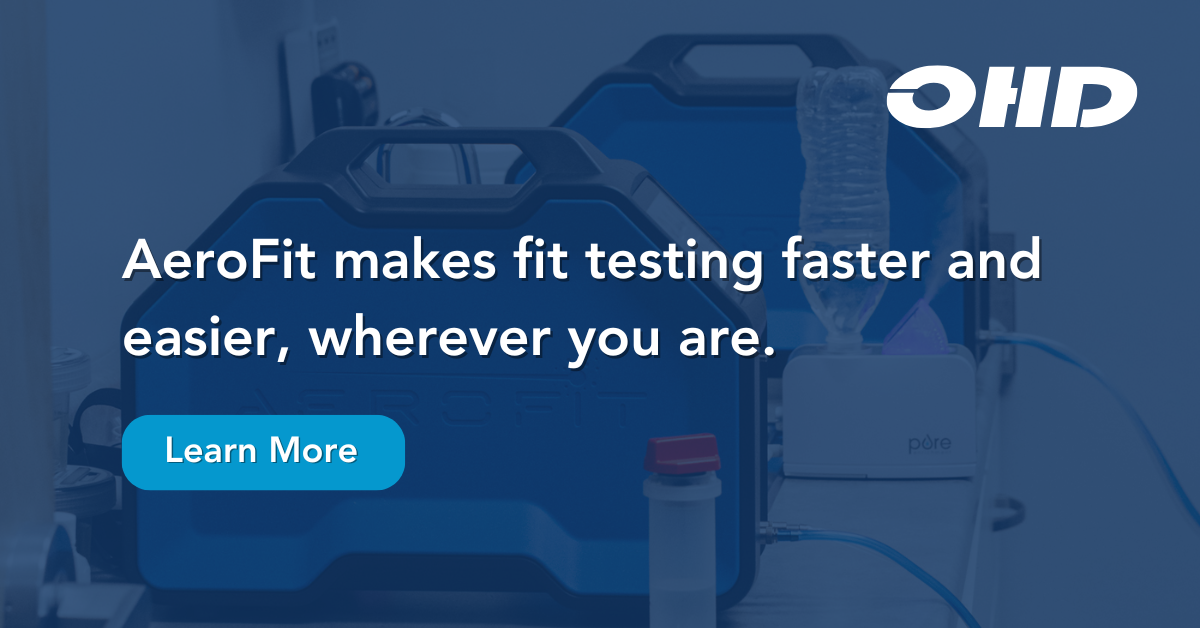
Not all quantitative fit testing devices are created equal. AeroFit was designed with hospitals in mind, making it one of the fastest and most user-friendly solutions available.
1. Simple, Intuitive Interface
Hospitals need fit testing solutions that are easy to use, especially in fast-paced healthcare settings. AeroFit’s intuitive color touchscreen and preloaded respirator lists simplify the process, reducing setup time and training requirements.
2. Faster, More Efficient Testing
AeroFit completes fit tests in under three minutes, significantly reducing the time burden on healthcare staff. Unlike qualitative testing, it does not require consumables, lowering overall costs.
3. Designed for Healthcare Environments
AeroFit operates silently, making it ideal for clinical settings. Our patent-pending particle generation management ensures particle count control in the fit testing environment, taking the guesswork out of particle management. It also features optional battery-powered portability, allowing fit testing to take place anywhere without needing to be plugged in.
4. Seamless Compliance & Data Management
AeroFit integrates with Logic Cloud, making it easy for hospitals to store, track, and manage fit testing data. Unlimited onboard storage ensures that compliance records are always accessible.
Overcoming the Hospital Buying Process
Hospitals face long procurement cycles, often taking 12-18 months to approve new equipment purchases. However, the benefits of AeroFit make it worth the investment:
- Long-Term Cost Savings – Eliminates consumable costs and reduces staff downtime.
- Easy Implementation – Designed for seamless onboarding, even for staff unfamiliar with quantitative testing.
- Faster Testing Means Less Disruption – AeroFit allows hospitals to fit test more employees in less time.
For healthcare facilities looking to improve efficiency, compliance, and worker safety, AeroFit is the ideal solution.
Now is the Time to Upgrade
Hospitals need fit testing solutions that are accurate, efficient, and easy to use. While qualitative methods have been the default for years, they are no longer the best option.
AeroFit is the future of fit testing in healthcare—offering speed, reliability, and a seamless user experience.
Ready to see how AeroFit can improve your hospital’s fit testing process?