Who Should be Performing Respirator Fit Tests?

Who Is Qualified to Perform a Fit Test?
While OSHA’s Respiratory Protection Standard spells out fit test procedures in detail, it does not address who is qualified to perform them.
29 CFR 1910.134 Appendix A specifies which steps to perform, how long each should last, and what constitutes a pass or fail. But the standard is largely silent on the person behind the instrument. There is no required training, no certification, and no formal competency standard for the individual administering the test. If the protocol is followed and results are documented, the employer is compliant.
That gap has real consequences. Consider quantitative fit testing: Condensation nuclei counting (CNC) instruments can produce what are known as suspiciously high fit factors, a result that looks like an excellent seal but may actually indicate an oversaturated ambient environment or a machine issue. Controlled negative pressure (CNP) instruments can display unusual graph behavior during a test that signals a problem the machine alone won’t flag. An experienced operator recognizes these signs. Someone handed the instrument that morning does not.
Qualitative fit testing is even more vulnerable. The procedures depend entirely on the operator: the sensitivity screening, the application of the challenge agent, the timing and number of squeezes. Get any of those wrong and the test becomes unreliable. An early-career industrial hygienist may learn the qualitative method from whoever held the job before them and never question it. Meanwhile, they could be applying the sensitivity test and challenge agent incorrectly, passing respirators that should have failed. That kind of inherited error is not unusual when there is no formal competency check in the process.
Other Countries Are Building Accreditation Schemes
Several countries that have adopted or expanded fit testing requirements in recent years have taken a different approach, building formal accreditation schemes for fit testers alongside the testing mandates themselves. These programs assess whether someone understands what they are doing and why, not just whether they can operate the instrument.
Fit2Fit (United Kingdom)
Fit2Fit launched in 2009, developed by the British Safety Industry Federation (BSIF) and endorsed by the UK Health and Safety Executive (HSE). Candidates must pass a written exam with an 80% threshold and complete a practical assessment. UK regulations require that fit testing be performed by a “competent person,” and Fit2Fit has become the recognized way to demonstrate that competency. The scheme is expanding into other parts of Europe.
RESP-FIT (Australia)
RESP-FIT was developed by the Australian Institute of Occupational Hygienists (AIOH) in collaboration with industry stakeholders. It is built on AS/NZS 1715 and ISO 16975.3:2023 and operates on a three-year accreditation cycle with reassessment. Completing an approved training course is not enough on its own. Candidates must also pass a separate accreditation assessment, including a video-recorded demonstration of the fit test process.
COMMIT2FIT (New Zealand)
COMMIT2FIT, run by the New Zealand Occupational Hygiene Society in collaboration with WorkSafe NZ, follows a similar competency-based model. The scheme is voluntary, but completing it is recognized as evidence of good practice under New Zealand’s workplace health and safety regulations. Commit2Fit currently only offers qualitative (saccharin and Bitrex only) and CNC.
So What About the U.S.?
Decades ago, the United States was ahead of most of the world in regulating respirator fit testing. That is no longer the case with regards to its approach to fit testing qualifications. Other countries are building structured programs from the ground up. The question is whether the U.S. will follow.
Organizations including AIHA, ACGIH, and ISEA have all explored the idea of a U.S.-based fit tester qualification scheme, consulting with the ISRP for guidance along the way. But so far, no organization has committed to building one, and there is no timeline.
What would a U.S. scheme even look like? And does every person performing a fit test really need the same level of training? Those questions are harder than they sound.
The Accreditation Landscape: Promising but Incomplete
The international schemes are a meaningful step forward. But they are not without limitations. Both Fit2Fit and RESP-FIT were built primarily around qualitative and CNC methods. Neither has fully addressed CNP as a distinct technology with its own operational considerations and passing criteria. For an accreditation scheme to serve the full profession, it needs to reflect the full range of technologies in use.
In the U.S., multiple organizations have discussed creating a qualification scheme. AIHA, ACGIH, and ISEA have each explored the idea, and each has consulted the ISRP for input. But these are volunteer-driven organizations, and volunteer groups sometimes struggle to assign ownership and drive something like this to completion. There is no timeline, and it is an open question whether the effort will come from an industry association or from a private entity that can move faster.
Does Every Fit Tester Need the Same Training?
This is the question at the center of the accreditation debate, and it does not have a clean answer.
Some industrial hygienists would argue that anyone performing a fit test should understand the underlying theory: how respiratory protection works, why fit factors matter, what the numbers actually mean, and how different testing methods compare. That knowledge helps operators recognize problems, interpret edge cases, and make sound decisions when something unexpected happens during a test.
That argument has merit. But it also assumes that every person operating a fit testing instrument is, or should be, an industrial hygienist. The reality in most programs is different. The person running the instrument is often a safety coordinator, a training officer, a nurse, or a technician. They need to operate their specific instrument correctly, follow the protocol, and produce valid results. They may not need a deep understanding of the theory behind every testing method.
What most programs actually need is both: an overarching industrial hygienist or program manager who understands the theory and can intervene when issues arise, and operators who are well trained on their specific instrument and can administer reliable tests day to day. The theoretical knowledge and the practical competency serve different roles in the same program.
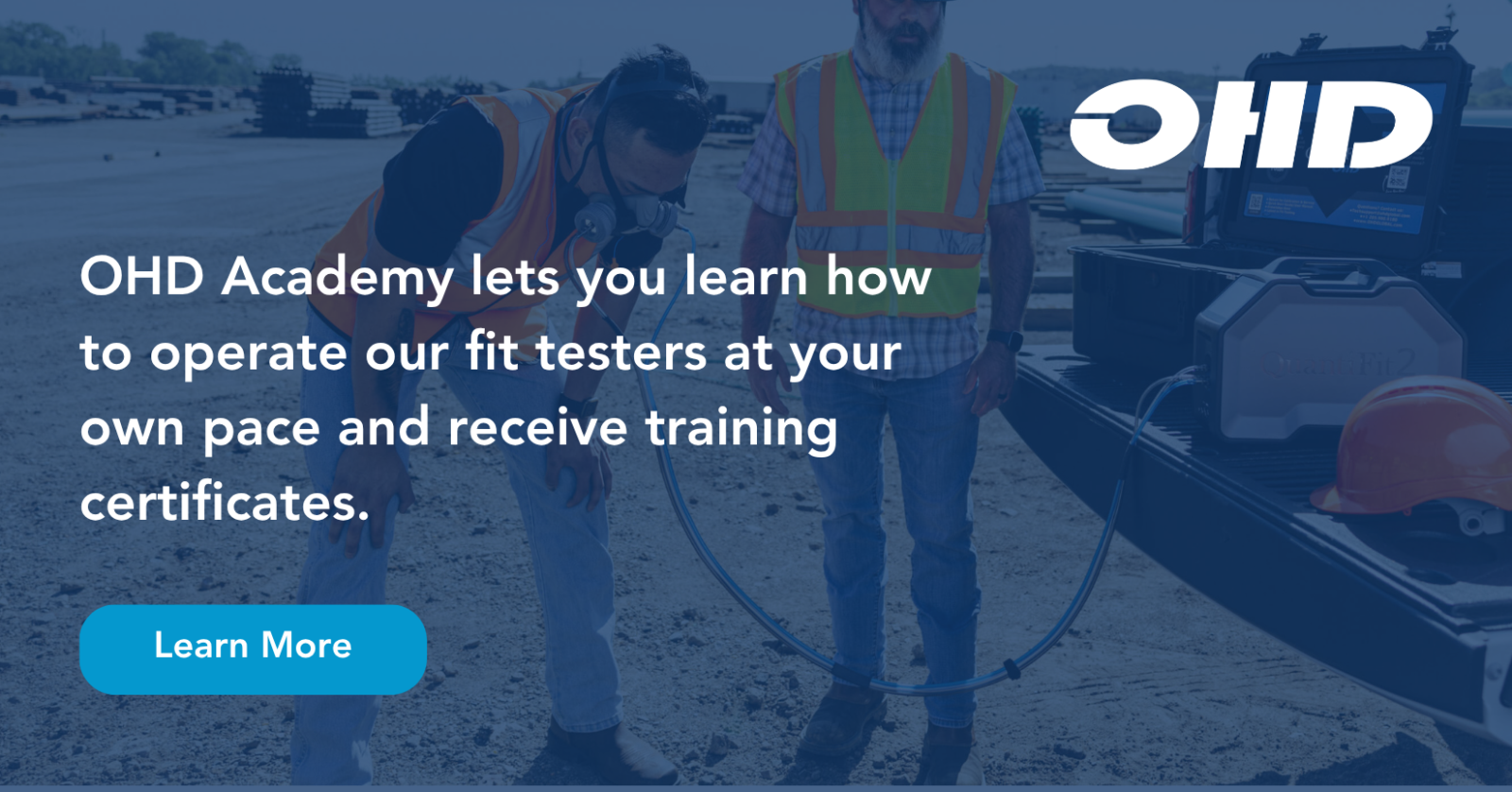
This is where manufacturer-led training has a role to play. Programs like OHD Academy train operators specifically on the technology they will use: the instrument, its protocols, its software, and the troubleshooting that keeps results valid. That kind of focused, instrument-specific training is a practical complement to broader respiratory protection education.
What You Can Do Now
A formal U.S. accreditation scheme may or may not materialize, but the absence of a mandate does not mean the absence of a need. Respiratory protection program managers can take steps now to strengthen the competency of the people performing fit tests:
- Evaluate who is performing fit tests in your program and what training they have actually received. If the answer is “they learned from the person before them,” that is worth addressing.
- If your instrument manufacturer offers a training or certification program, take advantage of it. At minimum, every operator should be trained on the specific technology they use.
- Document operator training as part of your respiratory protection program records. If an accreditation requirement does emerge, programs that already track competency will be ahead. OHD Academy offers certificates for every user who completes training.
- Pay attention to international developments. What is happening with Fit2Fit, RESP-FIT, and the ongoing U.S. discussions will shape expectations across the profession.
The global conversation about fit tester competency is still taking shape. These are genuinely open questions, and the industry has not settled on the answers yet. But the underlying question is one every program manager should be asking right now: is the person performing your fit tests actually qualified to do it? That is worth taking seriously, regardless of what OSHA requires.
The technology you test with matters, too.
OHD is the only company that makes both quantitative fit testing technologies. The QuantiFit2 uses controlled negative pressure (CNP) to fit test elastomeric respirators with no consumables. The AeroFit uses condensation nuclei counting (CNC) to fit test both N95 and elastomeric respirators. Whichever method your program uses, OHD Academy trains your operators on the instrument they run.